
A small problem with a personal starting point
Senior QNA began with a practical family need. My sister was preparing for a Class 9 multiple-choice competition, and I wanted to give her a simple way to practise questions across different subjects rather than relying only on static notes or repeated worksheets.
The first version was intentionally narrow: a lightweight quiz experience that could ask questions, collect answers, and make practice feel more immediate. She used it to prepare and did well in the competition. That early result was personal rather than a formal product metric, but it showed me that a focused practice tool could be genuinely useful.
Expanding the idea without losing the original purpose
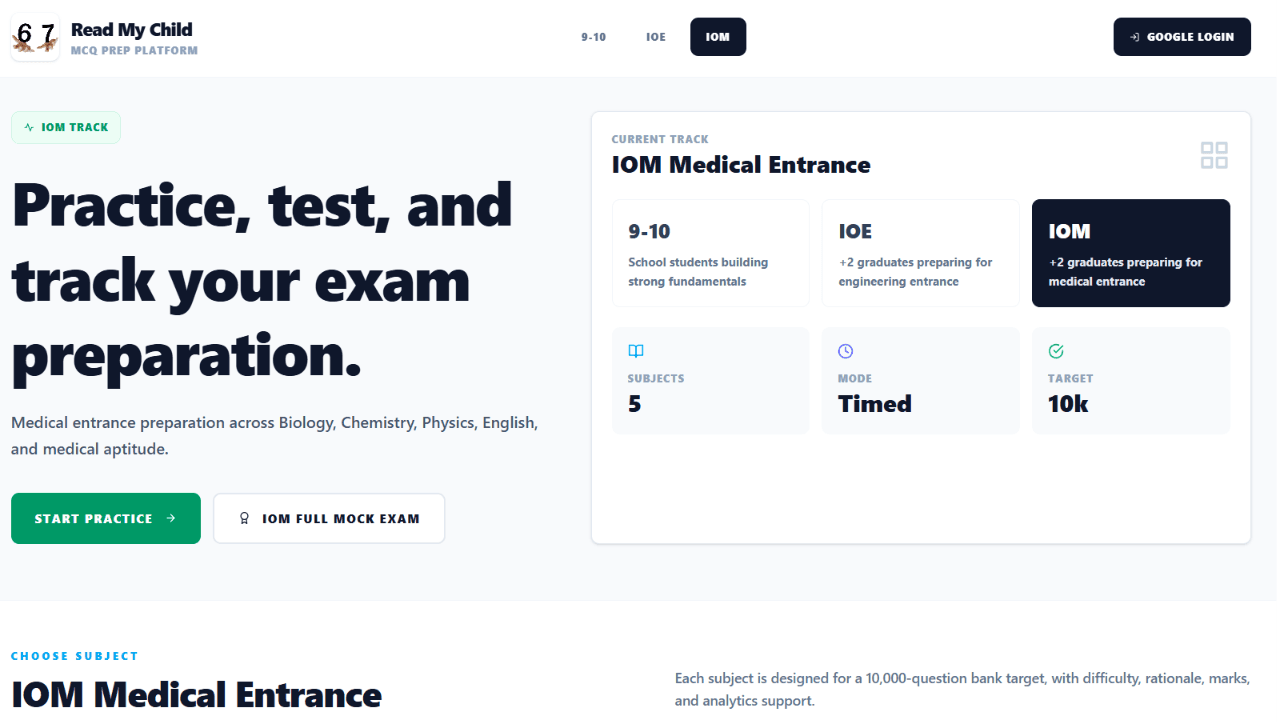
After the first version, I expanded the platform so that other learners could use the same idea. The scope grew from Class 9 practice into a broader preparation platform for Class 9-10, IOE engineering entrance, and IOM medical entrance learners.
The principle stayed the same: give learners a clear way to choose a course and subject, work through questions at a manageable pace, understand the result, and identify where to practise next. The challenge was to make the product more capable without turning a straightforward study session into a confusing system.
- Course and subject selection for Class 9-10, IOE, and IOM paths.
- Practice quizzes with selectable question sets and immediate feedback.
- Timed mock exams with navigation, marked-for-review state, and answer review.
- Result pages with scores, explanations, and subject-level progress signals.
Designing for practice, not only for scoring
A quiz is easy to reduce to right and wrong answers. I wanted the platform to be more useful than a score screen.
The learner flow therefore supports question progression, answer selection, explanations, summaries, and review after a session. Mock exams add the pressure of a timer while still allowing learners to move between questions, mark items for review, and check their answers before completing the session. In-progress attempts are preserved locally, so an interrupted session does not automatically become lost work.
For signed-in learners, results can be saved and viewed in a private progress dashboard. That turns individual attempts into a longer-term picture of performance across subjects and courses.
Building a content system that can grow responsibly
The difficult part of an exam-preparation product is not only presenting questions. It is maintaining a large enough question bank while being honest about quality and review status.
Senior QNA uses a mixed approach. Local manifests and generated JSON banks support learner-facing sessions at scale, while Sanity supports curated questions, result records, analytics, and administration. This avoids forcing a very large generated bank into the CMS while retaining a structured place for editorial and operational work.
I also added validation and review-oriented workflows around the question data. Checks can identify malformed records, duplicates, missing options, invalid answer indexes, weak topic variety, and uneven difficulty distribution. Reviewer samples and an academic-review ledger provide a way to document approval or rejection rather than assuming that generated content is automatically ready to present as reviewed.
Protecting learner and administrator workflows
The public learning experience and the administrative experience need different permissions. Learners need a simple route into quizzes and progress; administrators and reviewers need protected access to question management, results, analytics, launch checks, and academic-review records.
- Google-based sign-in for saved learner results and private progress views.
- Protected administration for question, result, analytics, and readiness workflows.
- Server-side result writes and server-only configuration for sensitive credentials.
- Launch checks covering authentication, bank coverage, quality, academic review, and deployment readiness.
What I handled
- Conceived and built the platform independently, from the initial Class 9 practice tool to the expanded multi-course experience.
- Implemented learner-facing quiz, mock-exam, result, and progress flows using Next.js, React, Sanity, and NextAuth.
- Designed the question-bank, validation, review, and launch-readiness workflow so growth would not require compromising quality claims.
Outcome and next steps
Senior QNA became a much more complete learning platform than the original competition-preparation tool. It now has a foundation for school and entrance-practice flows, authenticated progress tracking, curated content management, and evidence-based review controls.
The important outcome is not an unverified claim about score improvement or learner volume. It is that the original idea was tested by a real learner, then deliberately expanded into a platform that gives more learners structured practice and gives administrators a responsible way to manage quality.
The next meaningful step is academic: completing reviewer evidence for each subject before presenting generated banks as fully reviewed, then expanding course coverage only where there is a defined syllabus blueprint and review process.