
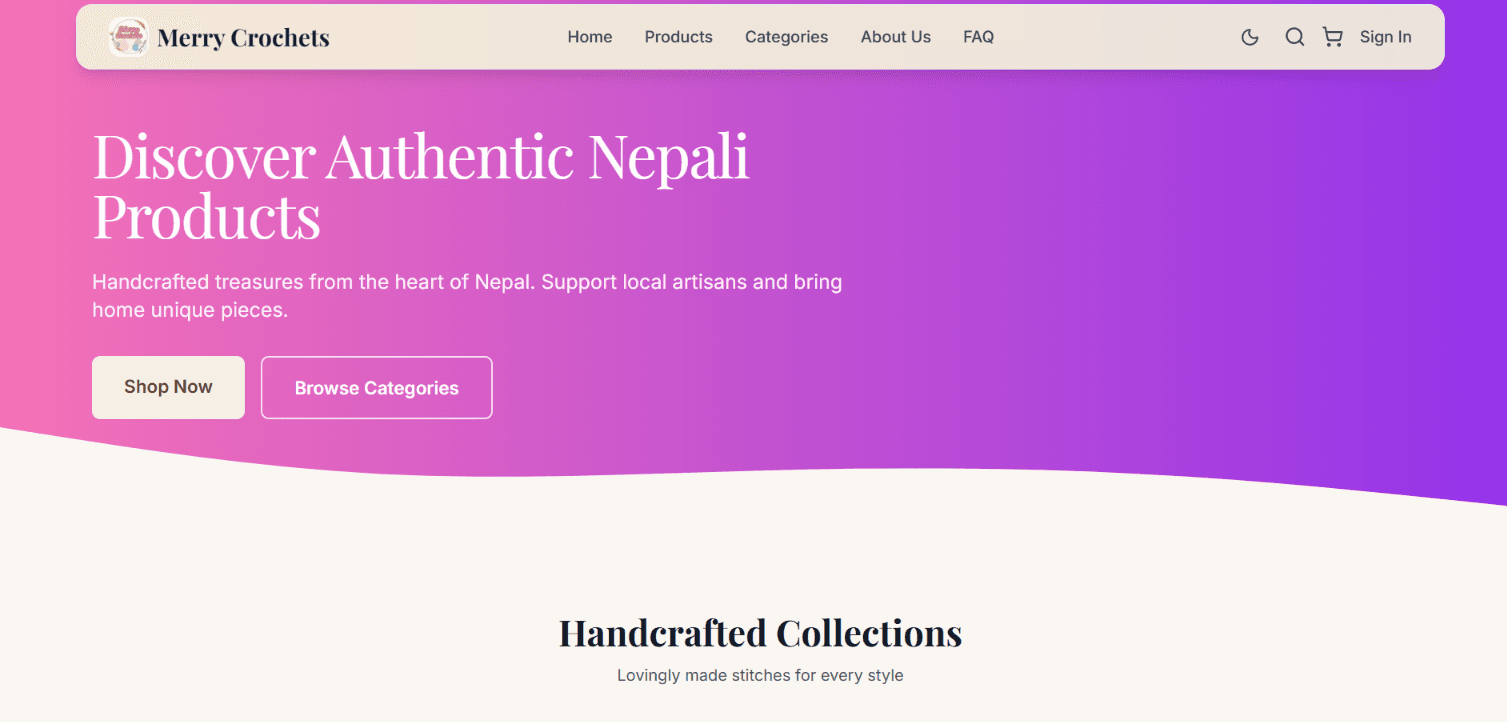
A handmade store needs more than a catalogue
Merry Crochets is a full-stack e-commerce platform for handmade crochet products, built during my internship at Niyalo Creatives. The goal was to make products easier to discover and purchase online while giving the people maintaining the store a practical way to manage products, stock, categories, and orders.
Handmade commerce has a different kind of complexity from a simple product catalogue. Customers need enough information to understand a product, its price, availability, and natural variation before they buy. At the same time, the team needs reliable content, inventory awareness, clear order records, and a workflow that does not require a developer for every product update.
Designing the customer journey
I built the public experience around the path a customer would realistically take: discover products, narrow the catalogue, inspect product details, save items, manage a cart, and move into checkout. The platform includes product and category pages, image galleries, stock messaging, search, filtering, sorting, a persistent cart, and an authenticated wishlist.
The interface also supports responsive layouts and light and dark themes. Those details matter because a customer should be able to browse comfortably from a phone as well as a desktop, without losing important product information or controls.
- Product, category, and detail-page experiences for discovery.
- Fuzzy search, suggestions, category filters, stock filters, price filters, and sorting.
- Persistent cart actions and authenticated wishlist management.
- Responsive presentation with accessible controls and customer feedback states.
Treating checkout as a system, not a button
Checkout was not treated as a purely visual form. It connects customer details, product selections, payment handling, order records, and follow-up communication. The project includes Stripe checkout and payment-verification infrastructure, webhook handling, customer order views, and cancellation or refund workflows for eligible orders.
The core lesson was that payment-related actions must be verified on the server before they change an order state. A customer-facing cart is useful for interaction, but it is not the final source of truth for an order. The application therefore keeps payment and order actions behind protected API routes and server-side checks.
Making ongoing content manageable
A commerce site only remains useful if products and categories can be maintained after development. I used Sanity CMS as the structured content layer for product records, category data, images, inventory-related attributes, orders, and wishlist data.
This gave non-technical operators a clearer route for maintaining the store. Instead of editing code to update a product or category, the team can work through structured records in the CMS. The same data foundation also supports administration views for inventory, order status, revenue summaries, top products, and low-stock awareness.
- Sanity-backed product, category, order, and wishlist records.
- Protected administration views for order and inventory work.
- Status updates and operational visibility for the order lifecycle.
- A content model that separates routine updates from application code.
What I handled
- Built the full-stack storefront with Next.js, TypeScript, Tailwind CSS, and structured Sanity content.
- Implemented product discovery, cart and wishlist workflows, checkout-related APIs, customer account journeys, and order views.
- Created the foundation for protected product, inventory, order, and analytics operations during my internship at Niyalo Creatives.
Outcome and reflection
Merry Crochets became a complete commerce foundation rather than only a visual storefront. It brings together customer discovery, structured product content, account workflows, checkout-related infrastructure, order visibility, and administrative operations in one application.
The project strengthened my understanding that e-commerce quality is determined by the connections behind the interface. Product content, stock, customer identity, payment verification, order status, and communication all need to agree with one another. The next responsible step is to validate every provider-dependent path in a production-like environment before treating it as a live operational result.