
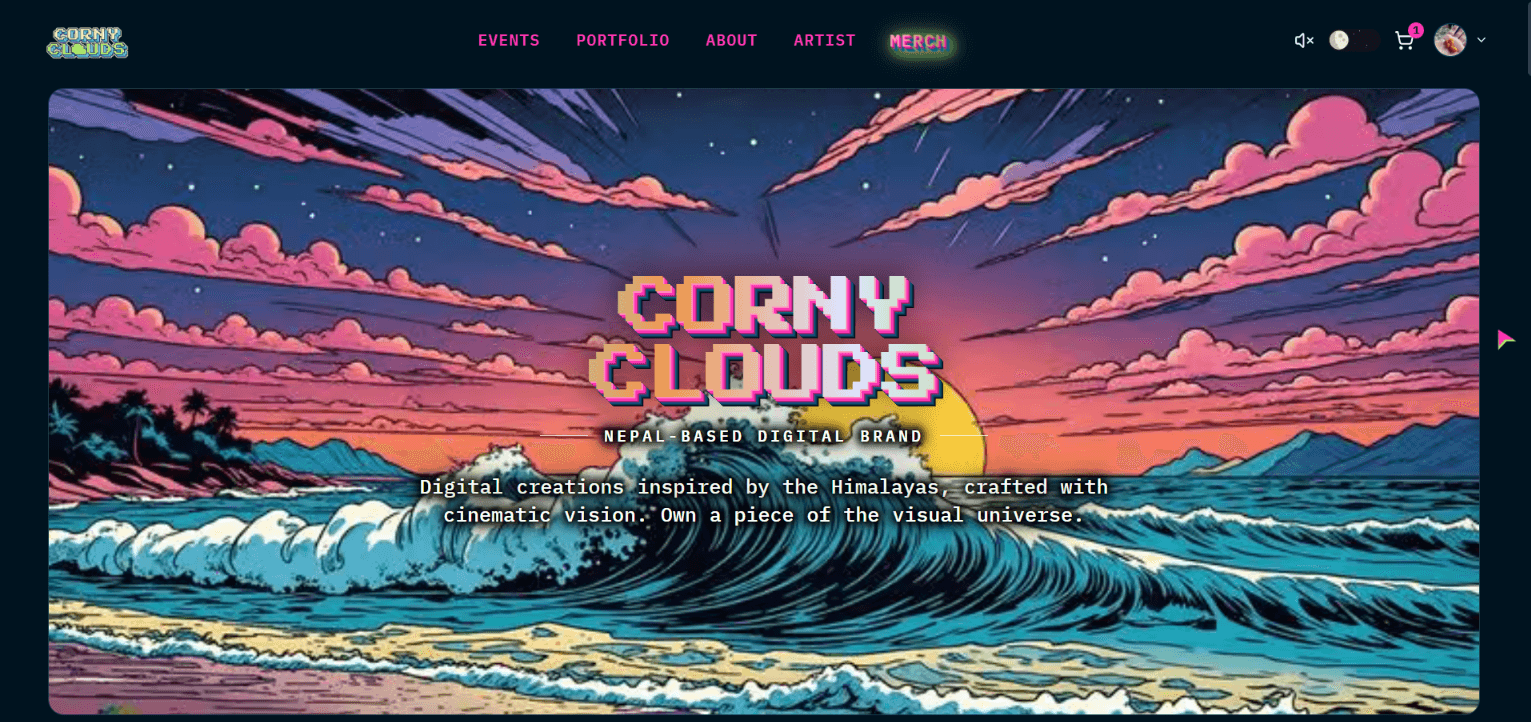
Corny Clouds is an artist-first web platform designed to bring independent artists, cultural events, portfolio work, merchandise, and audience relationships into one connected experience. The challenge was not simply to create a visually interesting website. Corny Clouds needed to preserve a bold creative identity while giving visitors practical ways to discover artists, learn about events, browse work, explore merchandise, and take action. Behind the public-facing experience, the platform also needed structured content management and a protected dashboard for ongoing operations. I worked on Corny Clouds as a Full-Stack Developer, contributing to approximately 64% of the final implementation. The project began as a collaboration, but I took on the majority of the work as it progressed, with guidance from senior team members. The result is a platform that combines expressive design with a practical technical foundation for content, commerce, customer accounts, and studio operations.
The problem: creative work was spread across too many separate places
For an artist collective or creative platform, audiences often have to move between multiple disconnected places. They may discover an artist on social media, find an event poster elsewhere, look for merchandise on a separate storefront, and have no clear way to understand the broader work or community behind it. Corny Clouds was designed to bring those experiences together. The platform needed to give different visitors a clear starting point:
- Fans needed to discover artists, events, merchandise, and updates.
- Event visitors needed access to event details, lineups, locations, ticket links, and related work.
- Customers needed familiar commerce features such as a cart, wishlist, checkout, and order visibility.
- Staff needed a way to maintain content and operations without requiring a developer for every update.
The product goal was to create one connected digital home for the Corny Clouds world without making it feel like a generic corporate marketplace.
Building around a strong visual identity
Corny Clouds already had a distinctive visual direction: pixel-inspired typography, monospace utility text, bright signal colours, tactile controls, motion, and both light and dark themes. That visual identity had to remain present throughout the platform, not only on the homepage. It needed to work across artist pages, event pages, merchandise listings, account flows, forms, and dashboard interfaces. One of the main design challenges was balancing expression with usability. The site needed atmosphere, but motion and visual effects could not make navigation difficult. The interface had to remain understandable on mobile devices, usable with a keyboard, and readable across different screen sizes. Satish Bajagain contributed to the design direction for the event experience and dashboard, as well as selected interaction details such as the loading screen and optional sound effects. I carried that direction through the broader implementation and worked on making the public and operational experiences function as one product. The result was a platform where the visual language supports the brand without replacing the practical purpose of each page.
Connecting discovery, events, portfolio work, and merchandise
The public experience was designed around discovery rather than a single linear journey. A visitor might begin by finding an artist, then explore their work, see an upcoming event, and eventually discover related merchandise. Another visitor might arrive for an event and then learn more about the artists involved. The information architecture needed to support these different paths without making the navigation feel crowded. The platform includes artist profiles, portfolio work, event records, merchandise discovery, categories, collections, and editorial content. Event-detail experiences can present key information such as dates, locations, status, lineup details, galleries, frequently asked questions, sharing controls, ticket links, and related merchandise where available. Instead of treating each section as an isolated page type, the platform was designed to make the relationships between them visible. Artists can be connected to events. Events can lead into related merchandise or portfolio work. Content can help visitors understand the creative identity behind the platform before asking them to make a purchase or submit an enquiry. This approach made Corny Clouds feel less like a collection of separate pages and more like a connected creative ecosystem.
Creating a CMS foundation for ongoing content
A creative platform changes frequently. New artists join, events are announced, products are released, portfolio work is added, and editorial content evolves. Hard-coding those updates would make the platform difficult to maintain. To make the site manageable over time, Corny Clouds uses Sanity as its content management system. The CMS structure supports content such as artists, events, portfolio items, products, categories, collections, testimonials, partners, reviews, subscribers, contact submissions, site settings, and brand story content. This allows content to be managed as structured records instead of requiring code changes for routine updates. The goal was not simply to add a CMS. It was to create a content foundation that could support the way the platform grows. A new event, artist profile, product, or portfolio item should be publishable through a clear workflow, while the public website remains consistent. This was one of the most important full-stack parts of the project because the value of a platform like Corny Clouds depends on its ability to stay active after the first launch.
Supporting commerce without losing the creative experience
Merchandise is part of the Corny Clouds experience, but it is not the only purpose of the platform. The commerce flow needed to feel connected to the brand while still providing the familiar behaviour customers expect from an online store. The product experience includes merchandise listings, categories, collections, product details, images, pricing, stock visibility, product options, reviews, search, filtering, sorting, cart management, and wishlist behaviour. The checkout flow includes server-side product validation, quantity and stock checks, Stripe payment-intent creation, order verification, and customer order records. Customer-facing account workflows support registration, login, profile updates, wishlist access, and order history. This work required careful attention to the boundary between what the customer sees and what must be validated by the application. A cart cannot be treated as the final source of truth. Product availability, selected options, quantities, and pricing need to be checked again by the server before a payment-related action is created. The project includes the technical foundation for payment and order workflows. However, I do not present it as evidence of live transaction volume, ticket sales, or revenue because those outcomes require verified production data.
Building protected customer and studio workflows
A public creative platform has different needs from a staff-operated system. Customers may need accounts, orders, and saved merchandise. Staff members need access to content and operational tools. Those experiences should not have the same permissions. Corny Clouds includes customer authentication through credentials and Google sign-in, along with session-backed account functionality. For staff operations, the platform includes a protected studio environment with role-aware access. The studio supports tools for managing artists, portfolio content, events, products, categories, orders, customers, brands, testimonials, reviews, contacts, subscribers, notifications, site settings, and dashboard users. This separation was important because it allowed the platform to support public creativity and internal operations without exposing sensitive administration tools to the public web. It also made the project more than a marketing site. Corny Clouds became a platform with real content and commerce workflows behind the presentation layer.
Making motion intentional and accessible
The Corny Clouds experience includes visual details such as motion, a loading treatment, optional sound interactions, and an expressive cursor style. These features help the platform feel more alive and aligned with its creative identity. However, decorative effects should never become a requirement for using the platform. The experience was designed so that key actions remain available without relying on animation or sound. Motion should respect reduced-motion preferences where supported, controls must remain visible and understandable, and users should not be blocked from browsing, navigating, or checking out because an effect did not load. This was an important lesson in creative frontend work: expressive interaction is valuable when it improves atmosphere, but it should never take priority over accessibility, clarity, or performance.
What I handled
- Built and refined most of the full-stack platform using Next.js, TypeScript, Sanity, and supporting integrations across public pages, customer flows, commerce features, and studio operations.
- Implemented and connected artist, event, portfolio, merchandise, account, CMS, and dashboard experiences into one structured product.
- Took ownership of approximately 80% of the project as the collaboration evolved, while carrying forward the shared visual direction and working under senior guidance.
Outcome: a creative platform with an operational foundation
Corny Clouds is live at cornyclouds.com . The outcome is not just a visually distinctive website. It is a structured platform that gives Corny Clouds a foundation for publishing artists, managing events, presenting portfolio work, maintaining merchandise, supporting customer accounts, and operating content through a protected studio workflow. The project is also a good example of why a case study should distinguish implementation from unverified business outcomes. The platform contains payment-intent, checkout, order, event, content, and account functionality, but I do not claim confirmed revenue, ticket sales, or growth metrics without evidence. That distinction matters. The value of the project is in the real product scope that was built: the systems, interactions, content workflows, and operational structure that make future growth possible.
Reflection
Corny Clouds taught me how much thought is required to make a creative platform feel cohesive. A platform can have strong visuals, but it still needs clear journeys, structured content, secure operational workflows, and interfaces that work for people on different devices. It can include animation and sound, but it must still respect accessibility and user control. It can support commerce, but it should not reduce every visitor journey to a checkout flow. The project helped me strengthen my full-stack thinking: not only how to build pages, but how to connect design, CMS structure, authentication, commerce validation, dashboard operations, and user experience into one maintainable system.